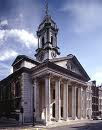
St George's Hanover Square

St George's Hanover Square

Sunday, 27 June 2010

He's made it!

Seamus is there! Yes, St George's much-admired verger, Seamus O'Hare, has completed his 500-mile pilgrimage to Santiago de Compostela. He arrived yesterday morning in time for an early Mass at the cathedral. And then it was off to the Pilgrim Office where he presented his credencial, stamped at each stop along the way to prove his entitlement to a compostela, the certificate pilgrims receive to mark their achievement.

I'm sure all who read this posting will join with the writer in congratulating Seamus on reaching his goal just 33 days after setting out.

Tuesday, 22 June 2010

News from Spain

Our intrepid pilgrim Seamus O'Hare, raising funds for St George's by walking 500 miles to Santiago de Compostela texts, 'looks like I will there on Friday'. As Friday is 25 July exactly one calendar month after he started walking, this means he's maintained a steady 16 miles a day. In fact he's probably done better than that because we know that dodgy tapas in Burgos caused a day's delay and we may reasonably presume there have been one or two rest days. So well done Seamus.

Watch this space for further progress reports!


Meanwhile some more of Seamus's excellent photographs.


Friday, 18 June 2010

Seamus tops £13k

Our intrepid pilgrim, Seamus O'Hare, now over half way along the 500 mile road to Santiago de Compostela, has now raised more than £13,000 for the Campaign for St George's. To be precise, an impressive £13,345.35 (including gift aid) has been donated or pledged by friends and well wishers. The slightly lower figure of £12,451.25 showing on the Just Giving web page www.justgiving.com/verger is because Just Giving show the gift aid element separately.

Readers of this page who have not pledged their support for Seamus - even if they are supporting the Campaign for St George's in other ways - are warmly invited to add to the current total. Wouldn't it be lovely to be able to greet Seamus on his return in early August with the news that his pilgrimage had raised more than £20,000?

Thursday, 17 June 2010

Site meeting

Each month there is a site meeting involving all those concerned with the work currently going on in St George's. This involves the architect and his consultants, the contractor and subcontractors and ourselves and provides us with an opportunity to review progress over the past month. Today we had our second such site meeting. This is what we saw:-

Mouldings stripped back to the plaster.


Work in progress.


Tantalising evidence that at some stage in the past the ceiling mouldings under the north and south galleries were painted red!


A sign of the times.


A sign (or signs) of times past


The East Window inspected . . .


. . . up close . . .


. . . and even closer - demonstrating that our Victorian forebears thought nothing of adding a few improving touches to the 16th century Flemish glass they were installing.


The organ case in an unaccustomed context.


Our Lady of Hanover Square.


Mid-twentieth century vandalism awaiting repair. (Forty years or so ago, it was decided to put down lights in the ceiling. Holes were cut in the plaster and roof joists simply cut through.)


Chandelier grids removed for renovation revealing . . .


. . . the remnants of the mechanism by which the chandeliers were raised and lowered.


The arch above the East Window.


The architect inspects evidence of early subsidence - subsequently stabilized and so no longer a danger.

Monday, 14 June 2010

On the pilgrim road

Seamus will I’m sure be the first to agree he is no technophile. But nothing daunted, not only did he acquire a mobile phone before leaving for Spain but since arriving there has sent back a string of remarkable photos which View from the Vestry can now share with his many friends.


Here i
s the first. Santiago de Compostela must have seemed a long, long way off.


Our hero on the road.


A convivial evening.


The cathedral at Burgos where he tells us he had to take a break from walking to recover from the effect of some 'dodgy tapas.'


Latest news has him over half way to his destination!

Seamus shows the way

The repair and refurbishment of one of the most important 18thcentury buildings in London – to say nothing of replacing the organ in Handel’s church – does not come cheaply. Later posts will deal in greater detail with the current fund raising campaign. The present piece is planned to be the first of many to trace the progress of a remarkable initiative undertaken by St George’s much-loved verger Seamus O’Hare to raise funds for the church he has served for the past sixteen years.

On 24th May, a month after the repair and refurbishment programm
e started, Seamus departed for south western France to begin a five hundred mile pilgrimage walk to Santiago de Compostela in Galicia in northwestern Spain, where legend has it that the remains of the apostle, Saint James the Great, are buried.

El Camino has existed for over a thousand years. It was one of the
most important Christian pilgrimages during medieval times, being considered one of three pilgrimages on which a plenary indulgence could be earned. There are a number of pilgrimage routes to Santiago de Compostela. However, since the late 10th Century the most famous and popular route is the Camino Francés which starts in the village of St-Jean-Pied-de-Port in France, crosses the Pyrenees, before passing through Pamplona, Logrono, Burgos, Sahagun, Leon, Ponferrada, Sarria and eventually into Santiago. This is the route that Seamus is taking, walking 500 miles, stopping where he can for rest and recuperation.

By the time of his departure, more than £12,000 had been donated or pledged to the St George's Hanover Square Foundation in response to
Seamus’s appeal to his many friends to sponsor his walk. It is not too late to add to this total. Donations can be made on line by following the link www.justgiving.com/verger .


Work begins

The long-anticipated work on the interior fabric of St George’s is now under way. The doors closed after the Patronal Festival Eucharist on Sunday 25th April and by eight o’clock the following morning work had started on moving the temporary organ, grand piano, hymn books and prayer books to One Mayfair, formerly St Mark’s, North Audley Street and on storing away other moveable items not be needed until Advent Sunday.

Then came the boxing up of the Handel House organ, the font, the pulpit and lectern, the laying of a protective flooring and the removal of the chandeliers for off-site repair and refurbishment.

Enter the scaffolders—


- and Health and Safety!


The principle contractors are Mayfair-based Holloway White Allom whose site office at St George's (with all mod cons and appurtenances) is now situated in the now empty organ case.

Sunday, 13 June 2010

Out with the old

Hot on the heels of the re-opening of St George’s after the current repair and refurbishment is completed will come the installation of the new organ. Indeed work on the instrument is already under way at Richards Fowkes and Company of Ooltewah, Tennessee. More of that in later posts.

However to prepare for the new instrument, clearly the old one has had to be removed and it was decided that this should be done before the current work started. This was to avoid having to take out unavoidably dusty organ components in a newly repainted church but it also affords us the opportunity of carrying out restoration work on the organ case while the church is scaffolded for refurbishment. Considerable effort was made late last year to find a buyer for the 1970s Harrison organ but to no avail until at the eleventh hour contact was made with the German organ builders Krawinkel, part of whose business is the refurbishment of redundant instruments.

Herr Krawinkel and his team arrived at 3.00pm on Monday 8th February. By midday on Thursday 11th the entire instrument had been dismantled and the following day it was loaded up into a truck and on its way to Germany.
We are fortunate that Malcolm Crowthers was able to come into the church to photograph this operation. The picture shown here is but one of many he took.

Preliminaries

The restoration, repair and refurbishment now actively under way in St George’s actually began last summer. We had earlier been advised that the church had serious structural problems which required urgent remedial action. Although further investigation had revealed this not to be the case, there was clearly a need for a comprehensive review of the condition of the fabric with particular reference to the roof timbers and high level plaster. However none of this could be done without clearing the roof void. Quite simply the accumulated detritus of 285 year made it impossible to see the fabric in the roof space let alone assess its condition.

George Cook & Sons, specialist plasterers and conservators of Cambridge, were therefore retained to clear the roof void and to begin the task of inspecting and assessing the condition of the fabric. Over two months during July and August 2009, no less than six tons of dust, rubble and pigeon droppings were removed revealing much of interest.

First, the good news. The fabric was by and large in good condition. The roof timbers were sound, the plaster ceiling would need relatively little attention and visible damage to the high level plaster work on the north and south walls was no worse than expected. In a less happy state were the ceiling joists cut through when ceiling lights were installed some 40 years ago. It had already been decided for aesthetic reasons to remove these and restore the integrity of the ceiling. What now became apparent was that such a step would be essential for structural reasons. In installing their new lighting system back in the early ‘70s, our precursors had simply cut through the joists without providing any structural alternative. As a result for the past forty years or so instead of contributing to the support of the roof, no fewer than twenty joists had simply rested on the ceiling.

Although St George’s was built in the early 1720s, like most churches in active use what we see today is a building that has been extensively modified over the years. One only has to compare the pews and pulpit in 18th century prints with the way they appear today to see what this can entail. Less immediately obvious are the things that have been changed and subsequently abandoned leaving no generally visible evidence. In 1854, gas lighting was introduced at St George’s. No evidence of this remains in the body of the church. However above our heads in the roof have remained a dozen or more wooden ventilation ducts. Many of these were in a poor state of repair and have now been removed.

Rather more interesting perhaps has been the number artefacts that have emerged from the roof debris including several hundred oyster shells and a rather fine clay pipe. Clearly issues of ‘health & safety’ were not uppermost in the minds of the early eighteenth century contractors who built St George’s and it is probably not overly fanciful to think of workmen lunching on oysters among the roof timbers before returning to work puffing at their clay pipes.