The restoration, repair and refurbishment now actively under way in St George’s actually began last summer. We had earlier been advised that the church had serious structural problems which required urgent remedial action. Although further investigation had revealed this not to be the case, there was clearly a need for a comprehensive review of the condition of the fabric with particular reference to the roof timbers and high level plaster. However none of this could be done without clearing the roof void. Quite simply the accumulated detritus of 285 year made it impossible to see the fabric in the roof space let alone assess its condition.
George Cook &  Sons, specialist plasterers and conservators of Cambridge, were therefore retained to clear the roof void and to begin the task of inspecting and assessing the condition of the fabric. Over two months during July and August 2009, no less than six tons of dust, rubble and pigeon droppings were removed revealing much of interest.
First, the good news. The fabric was by and large in good condition. The roof timbers were sound, the plaster ceiling would need relatively little attention and visible damage to the high level plaster work on the north and south walls was no worse than expected. In a less happy state were the ceiling joists cut through when ceiling lights were installed some 40 years ago. It had already been decided for aesthetic reasons to remove these and restore the integrity of the ceiling. What now became apparent was that such a step would be essential for structural reasons. In installing their new lighting system back in the early ‘70s, our precursors had simply cut through the joists without providing any structural alternative. As a result for the past forty years or so instead of contributing to the support of the roof, no fewer than twenty joists had simply rested on the ceiling.
Although St George’s was built in the early 1720s, like most churches in active use what we see today is a building that has been extensively modified over the years. One only has to compare the pews and pulpit in 18th century prints with the way they appear today to see what this can entail. Less immediately obvious are the things that have been changed and subsequently abandoned leaving no generally visible evidence. In 1854, gas lighting was introduced at St George’s. No evidence of this remains in the body of the church. However above our heads in the roof have remained a dozen or more wooden ventilation ducts. Many of these were in a poor state of repair and have now been removed.
Rather mor e interesting perhaps has been the number artefacts
  that have emerged from the roof debris including several hundred oyster shells and a rather fine clay pipe. Clearly issues of ‘health & safety’ were not uppermost in the minds of the early eighteenth century contractors who built St George’s and it is probably not overly fanciful to think of workmen lunching on oysters among the roof timbers before returning to work puffing at their clay pipes.

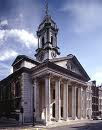
 The long-anticipated work on the interior fabric of St George’s is now under way. The doors closed after the Patronal Festival Eucharist on Sunday 25th April and by eight o’clock the following morning work had started on moving the temporary organ, grand piano, hymn books and prayer books to One Mayfair, formerly St Mark’s, North Audley Street and on storing away other moveable items not be needed until Advent Sunday.

 The principle contractors are Mayfair-based Holloway White Allom whose site office at St George's (with all mod cons and appurtenances) is now situated in the now empty organ case.


